
A canteen tea break has a rhythm of its own. Two hundred people walk in over twenty minutes, the queue moves, and whatever is on the counter has to survive the last fifteen minutes of it as well as the first five. That is why a canteen snack menu for 100 people is a counting exercise before it is a menu: portions per head, trays per slot, and packs that stay crisp once opened.
This guide gives the numbers. You get a portion chart per head, a four-item sample menu with the exact pack counts, the tray and queue layout, a step-by-step serving method, and how to store opened bulk packs through a working week.
Start With Portions Per Head, Not With a Snack List
Most canteen orders go wrong at the total, not the item. A manager picks snacks they like, orders a fixed number of cartons, and ends up with three trays of one thing untouched and nothing left of another. Work the other way: fix the grams per head first, then choose items that fit those grams.
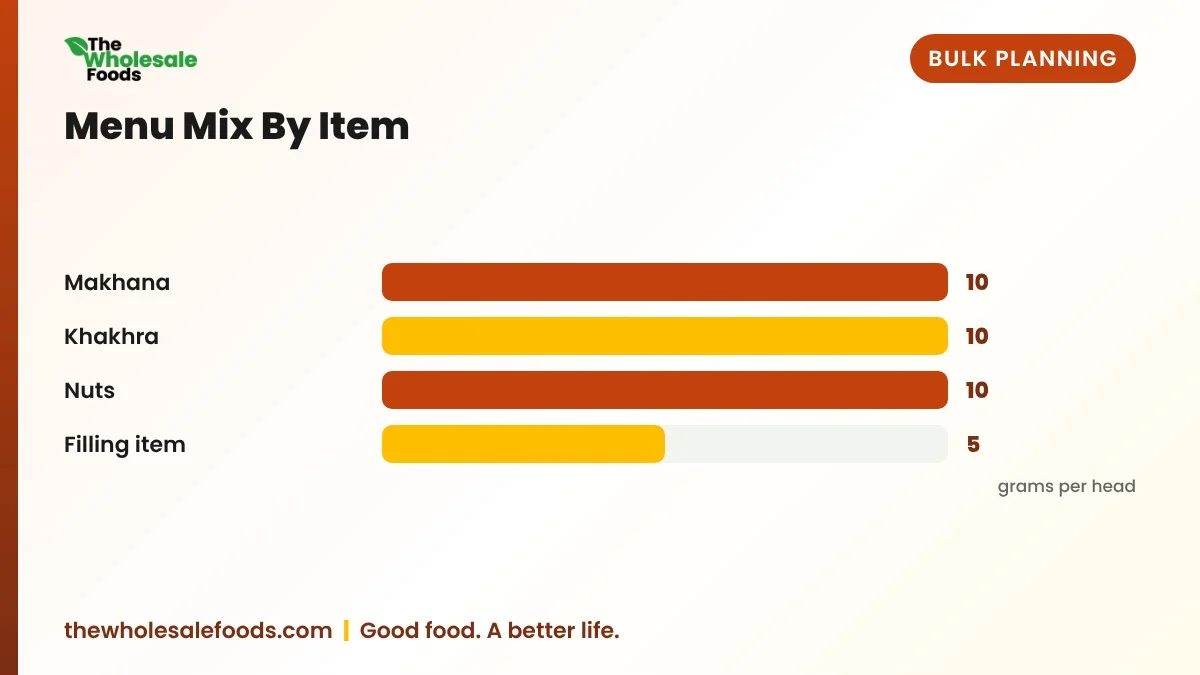
A tea break portion sits at 30-40 g per person. Below 25 g the tray looks empty and people complain; above 50 g you are feeding lunch, not tea. Split that 30-40 g across four items so nobody stands in front of a single tray.
| Item | Portion per head (g) | Packs of 100 g per 100 people | Note |
|---|---|---|---|
| Makhana | 10 | 3-4 | Light, low waste |
| Khakhra | 10 | 4-5 | One round is about 10 g |
| Nuts | 10 | 2-3 | Slower to eat, filling |
| Granola or cookies | 5-10 | 2 | Sweet slot |
| Total | 30-40 | 11-14 | One tea break |
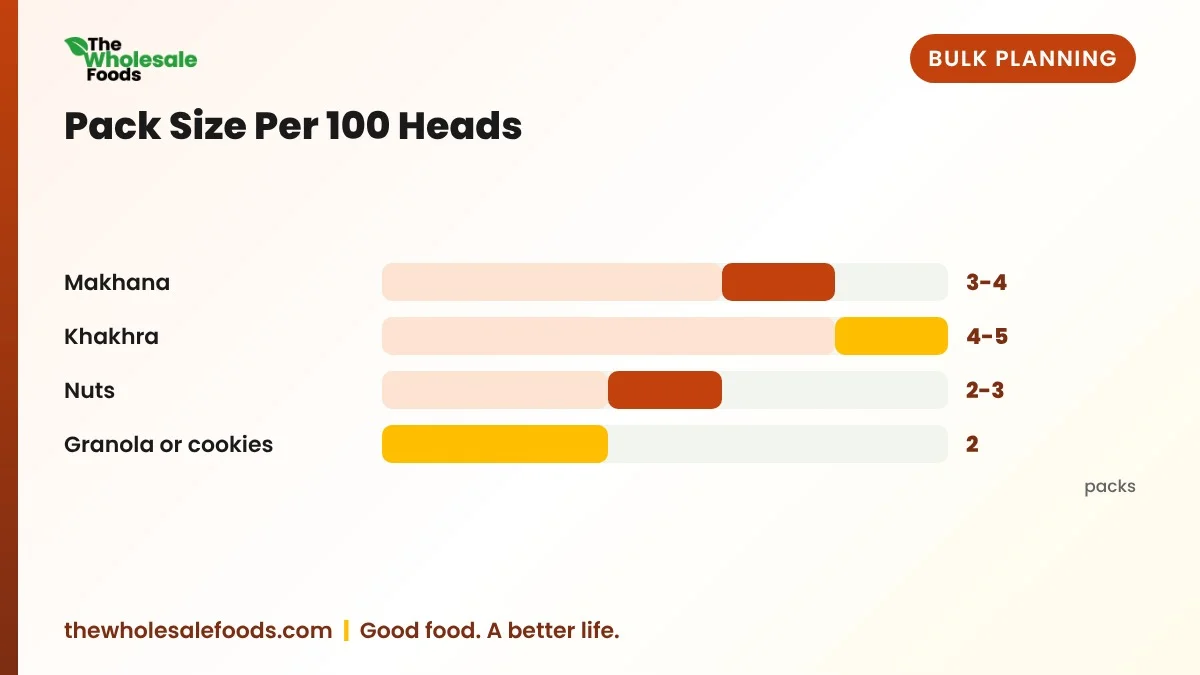
Makhana and khakhra look bulky but weigh little, which is why both need 10 g each. Nuts are dense, so 10 g already feels like a handful. The sweet slot stays small because it is the first item to sit untouched on a tray.
Pick Four Items, Not Twelve
A canteen counter with eight bowls looks generous and performs badly. Every extra item adds a scoop, a tray, a spill and a leftover. Four items cover the four things a person actually wants at tea: something light, something crunchy and salty, something that fills, and something sweet.
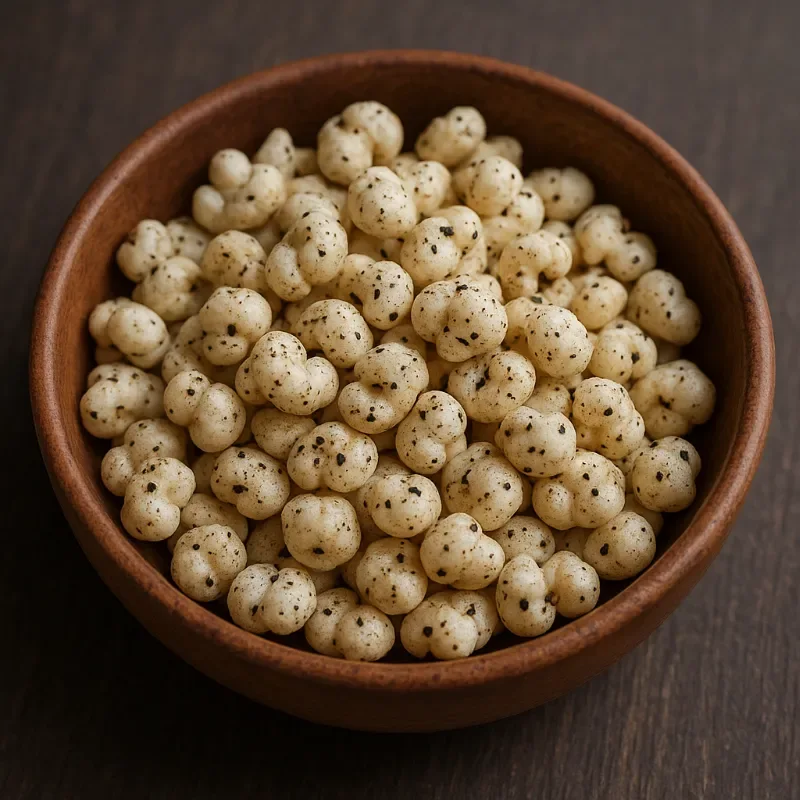
- Light and salty. Roasted makhana carries the biggest crowd because it is eaten by hand, needs no plate, and stays crisp in humid air. Peri-Peri Makhana and Black Pepper and Salt Makhana work as the two flavour slots.
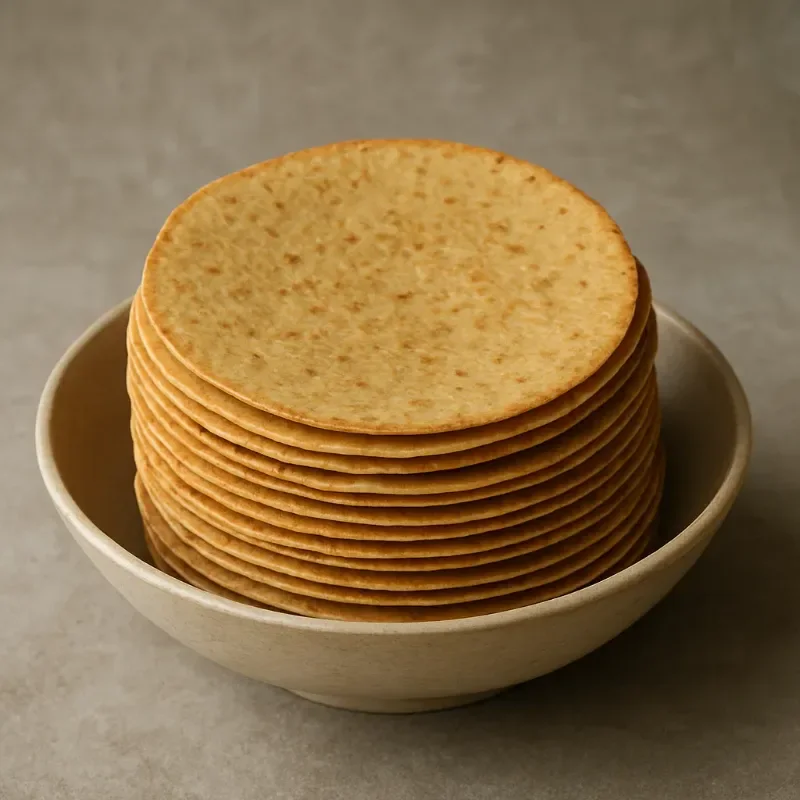
- Crunchy and dry. Khakhra does the Gujarati palate work and pairs with the tea itself. Keep one plain and one spiced so the sweet eaters have an option: Plain Khakhra and Masala Khakhra.
- Filling. A handful of nuts or a spoon of granola stops the 4 pm slump. Plain Almonds and Original Granola both hold on a tray without going soft.
- Sweet, small. Two cookies or a jaggery option close the break. Oats Jaggery Cookies suit a canteen better than anything chocolate, which softens in an open bowl.
Swap one item a week rather than all four. The mix feels new and your costing stays stable. If you want a wider look at what to keep on the shelf, this Office pantry bulk guide covers the same stock from the pantry side.
A Sample Week at 100 Heads a Day
Say you run a factory canteen with 100 people on the evening shift, five days a week, one tea break a day. That is 30-40 kg of snack a week at 30-40 g a head, split across the four slots.
| Day | Menu | Packs of 100 g | Note |
|---|---|---|---|
| Monday | Makhana, jeera khakhra, almonds | 9 | Light start |
| Tuesday | Pudina makhana, plain khakhra, granola | 9 | Crunch day |
| Wednesday | Makhana, methi khakhra, cashews, cookies | 11 | Heavier day |
| Thursday | Two makhana flavours, ghee khakhra | 9 | Low waste |
| Friday | Mixed counter, all four slots | 12 | Week-end spread |
| Weekly total | Four slots rotating | 50 | About 10 g per head per item |
Five days at 11-14 packs a day lands near 50-60 packs of 100 g a week for one break. Add a second break and the count doubles, which is where wholesale cartons start to make sense instead of daily retail buying. A hostel or student kitchen runs the same arithmetic with a different mix, covered in Bulk snacks for hostels.
Set the Counter So the Queue Moves
The food matters less than the line. A single serving point clears about 20-25 people in ten minutes; two points double that. For 100 people arriving over twenty minutes, plan two points with four trays each.
- Two points, not one. Split the menu so the sweet slot sits at the far end of each line and nobody backtracks across the queue.
- One scoop per tray. Assign a scoop or a paper cup size to each tray so portions do not drift upward in the first ten minutes.
- Half-fill the trays. A tray loaded with 1.5 kg looks thin by the end. Load 750 g, keep the rest sealed, and refill twice.
- Paper cups over plates. A 50 ml cup holds one portion exactly and removes the washing and the stacking.
- Keep the sweet slot last. Sweet items are eaten slowly and left half-finished; putting them at the end keeps them off the busy trays.
For a wedding or festival counter where people graze rather than queue, the same four-slot logic applies at a larger scale, as in this Wedding snack counter guide.
Enjoying this read? Get more like it.
Get fresh snack inspiration and updates from our team.
How to Serve the Break Without Waste
- Count the heads, not the appetite. Confirm the number on duty for that shift and multiply by 35 g. That is your day's ceiling.
- Open only what the trays need. Two makhana packs and five khakhra packs cover 700-800 g; leave the rest sealed in the store room.
- Pre-portion the slow movers. Nuts and cookies go into 10 g paper cups before the break, so a server hands one out instead of scooping.
- Refill on a timer, not on sight. Walk the counter at the eight-minute mark and top up the two emptiest trays together.
- Log what comes back. Weigh or count leftovers once a week for four weeks. Two weeks of the same leftover item means cut it, not discount it.
- Close the loop with the supplier. Tell your supplier which two items finished empty and which one came back; that changes the next carton faster than any menu rewrite.
If your canteen also serves guests or a festival day, the guest-facing version of the same spread is in Savoury makhana and khakhra snacks for guests.
What to Check Before Buying in Bulk
A carton that looks cheap per kilo can cost you more once three of its ten packets go soft in a humid store room. Run these checks before you place a bulk order.
- Pack size. 10 pouches of 100 g per carton suits a canteen because one pouch is roughly one tray. Big loose sacks are cheaper per kilo and almost always give trouble after day two.
- Shelf life on the pack. Check the best-before date on every carton on arrival, not on the invoice. Rotate stock so the earliest date opens first.
- Ingredient list. Fewer ingredients store better. Anything with sugar or chocolate softens faster in an open bowl than a salted roasted item.
- Storage fit. Measure your store shelf before ordering. Cartons should sit off the floor on a rack, away from the wall and the water cooler.
- Samples first. Order one carton of two or three items and run one break before committing a month. A 100-person canteen gives you a clean test in a single evening.
- Labelling. If you repack into jars, write the item name and the pack's best-before date on the jar. This matters for cafeterias with a food-safety audit.
Buy from a supplier holding a valid FSSAI licence and ask for the licence details with the quotation. For a canteen, cafe or hostel kitchen, bulk enquiries go through Quick Order or the Contact page.
Storage and Freshness for Opened Bulk Packs
Makhana and khakhra fail in canteens for one reason: an opened pouch left standing in humid air. Roasted fox nuts go leathery in a day in coastal humidity, and khakhra loses its snap overnight.
- Transfer to airtight jars within an hour of opening a pouch, and use a wide-mouth jar so hands do not crush the contents.
- Keep a dry scoop in each jar. A damp spoon is enough to soften a whole tray by the next break.
- Store below room temperature and out of sun. A shaded rack beats a counter under a window in every season.
- Do not refrigerate dry snacks. Condensation forms the moment a cold jar meets warm air.
- Write the opening date on the jar. An opened pouch of khakhra is best within 7-10 days; sealed pouches keep to the date printed on the pack.
- Never decile two batches into one jar. Different best-before dates in one jar means you cannot rotate stock.
In winter, dry snacks hold well and only the sweet slot needs watching. In monsoon, cut the number of open pouches on the counter and refill more often.
Festive and Special Days at the Same Counter
A festival break is the same 100 people with a higher expectation. Keep two of your four regular slots and change the other two, rather than building a separate festive menu that nobody can repeat.
Dry fruit granola, jaggery cookies and a flavoured almond tray read as festive without any cooking. Add a small box or a paper cup with a ribbon and the same counter becomes returnable gift for staff, which is the cheapest gifting a canteen can do. The Corporate snack gift box checklist covers packing that into boxes. If your festive menu leans sweet, this Healthy Diwali snacks list helps you balance the trays.
Count grams per head first, then choose the snacks; the other way round is how canteens end up with leftovers and complaints.
Conclusion
A working canteen snack menu for 100 people comes down to 30-40 g per head across four slots, two serving points, half-filled trays and airtight jars for whatever is left opened. Fix the portion chart, run one week, log the leftovers, then adjust the mix. That cycle gets you a stable menu faster than any long planning meeting.
Browse the Makhana range, the Khakhra range and the Nuts range on the site, or see everything in the Shop. For a canteen, hostel, cafe or event counter, send your quantities through Quick Order or write to sales@thewholesalefoods.com.
Disclaimer: This article is general food and nutrition information, not medical advice. People with health conditions or allergies should follow their doctor's advice.