
A hostel common room at 6 pm looks the same everywhere. Two hundred students come off classes, the canteen is crowded, and whatever was bought in the last round has gone soft, gone stale or gone missing from the shelf. If you are the warden, the hostel caterer or the manager of a PG block, the question is rarely which snack tastes best. It is which snack survives three months in a store room, survives being opened and re-opened, and still reaches the student in good condition.
This guide covers hostel snacks for students bulk buying end to end: how much to order for a term, which items hold up in a shared store room, how to set portions so a stock lasts, and what to check on the invoice before a single carton is accepted. It assumes a mid-size hostel of about 120 students on a 90-day academic term, and the same maths scales down to a 40-bed PG or up to a college canteen.
Work Out the Real Numbers Before You Order
Every bad bulk order starts with a guess. Write down four numbers first: the number of students, the number of days in the term, how many snack services you run a day (usually one, at 5 to 6 pm), and the portion you are willing to serve. A snack portion for a young adult is 25 to 30 g, which is roughly one handful.
Say you stock for 120 students over 90 days at 25 g a head. That is 270 kg of snack for the term, or 3 kg a day. Split across four or five items so no single item runs out first, and keep about 10% aside as buffer for exam-week demand and spillage. If you have run the pantry before, use last year's issue register instead of a formula, because actual take-up is always higher than planned.
What Actually Gets Eaten in a Hostel
Hostel eating has its own rules, and they are different from an office pantry. Students eat standing, walking and while studying, so anything that needs a plate, a chutney or both hands fails. Late-night study sessions move a lot of volume, so the stock has to stay crisp after the packet is opened.
- Crunch survives the room. Dry, crisp items disappear first because they are eaten by the handful. Soft bakes sit on the shelf and go stale once opened.
- Savoury beats sweet at chai time. Salt and spice items are taken with tea. Sweet items work better in the breakfast slot than the evening one.
- Strong flavours spread complaints. Ten packets of very hot snacks in one shared counter will draw objections from a section of the hostel. Keep the hot variants to about a quarter of the mix.
- Protein keeps students longer. A handful of nuts or a spoon of granola holds hunger through a three-hour study block better than a light puffed snack.
- Familiar Gujarati names help. Khakhra, gathiya and namkeen need no explanation, which matters when the hostel has students from many states.
For a fuller list of what works in shared pantries, see the Office pantry bulk guide, which covers the same logic for a desk-bound crowd.
Build the Term Mix Around Four Slots
Do not buy by brand. Buy by slot, so every part of the day and every kind of hunger has an answer. A workable mix for a hostel counter is a light salt item, a heavy bite, a sweet for breakfast and a nut.
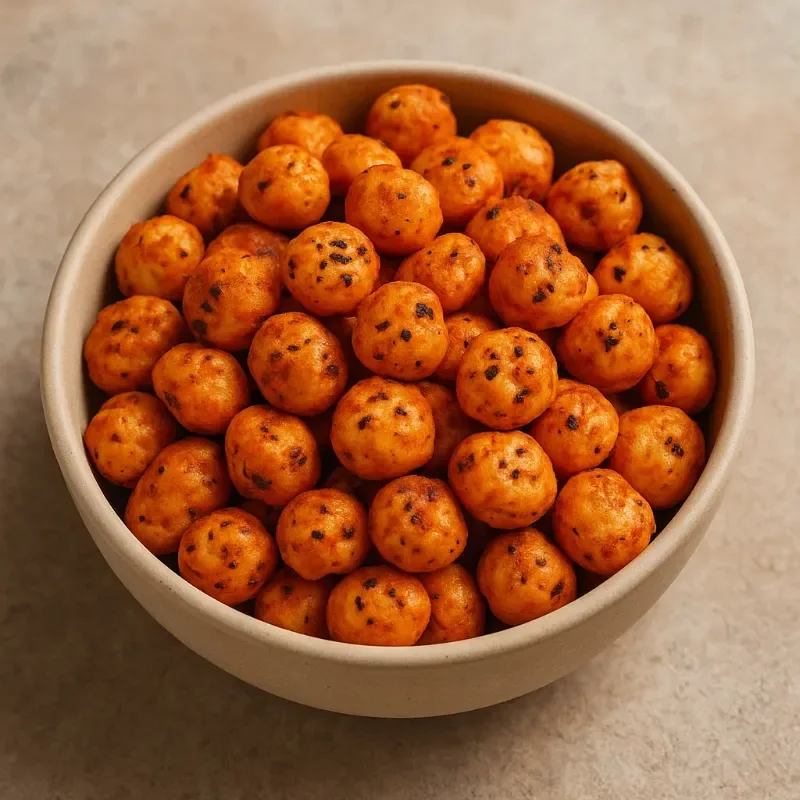
- Light salt (40% of weight). Roasted makhana in plain, Himalayan salt or Black pepper does the most volume per rupee and per gram, and it is light to carry up the stairs to the store room.
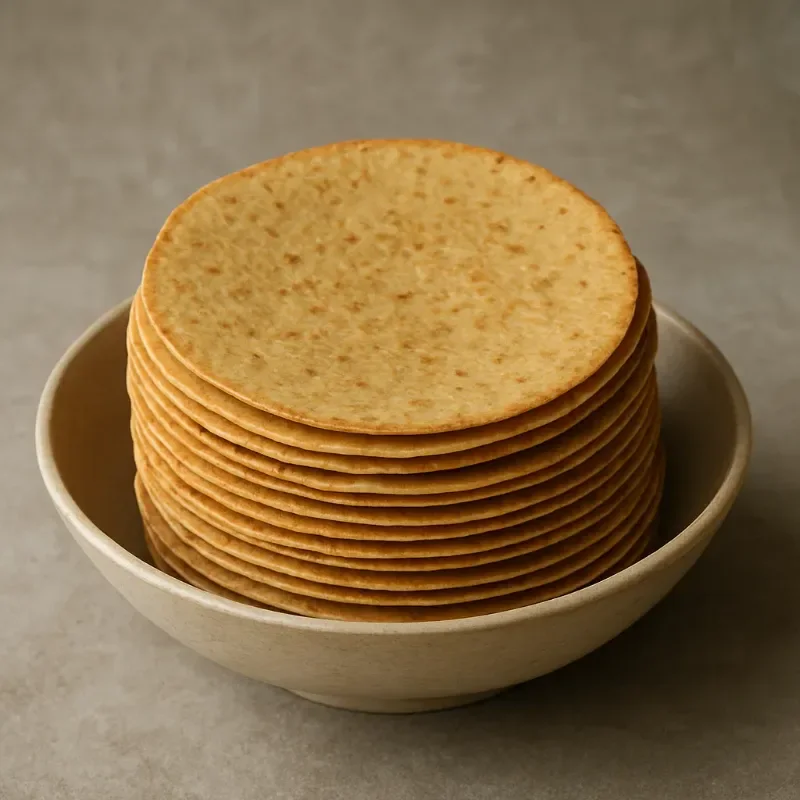
- Crunch with a meal feel (25%). Plain khakhra and Masala khakhra break into halves that fit a book bag, and Methi khakhra gives the fenugreek flavour many students recognise from home.
- Nuts and protein (15%). A 20 to 25 g portion of Plain almonds or Peri-peri almonds covers the late-evening study crowd.
- Breakfast sweet (20%). Baked Oats cookies and Coconut cookies go with milk at 7 am, and Original granola works where milk and curd are served.
Two flavour families are enough. Add one hot item such as Peri-peri makhana and stop there, because the more variants you carry, the faster each one ages on the shelf.
How Many Packs a Term Needs
Wholesale snack packs usually arrive as 10 pouches of 100 g, so a carton is 1 kg. That makes the maths easy: 3 kg a day for 120 students is roughly three cartons a day, or 270 cartons across 90 days. The split below keeps the mix balanced without any one item finishing early.
| Slot | Item | Packs of 10 x 100 g | Note |
|---|---|---|---|
| Light salt | Roasted makhana | 36 | Highest volume, eaten fastest |
| Crunch | Khakhra | 27 | Two rounds per student per serve |
| Nuts | Flavoured almonds | 18 | 20-25 g portion, restrict to one scoop |
| Breakfast | Granola | 27 | Served with milk or curd, morning only |
| Breakfast | Oats cookies | 18 | One biscuit per student |
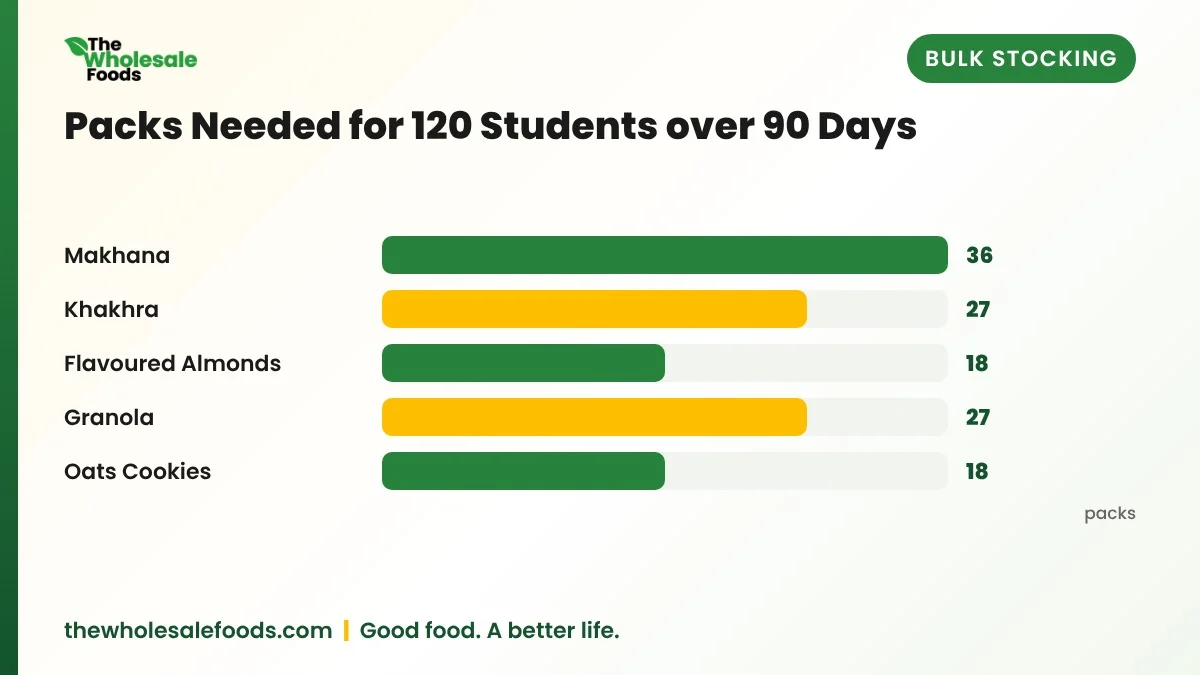
Makhana and khakhra carry the counter because they are light and dry. Nuts are the costliest line per gram, which is why the almond quantity is the smallest and the portion is capped. Granola looks large in pack count but is served with milk, so the actual dry weight per student is only 30 to 35 g.
Set the Portion or Lose the Stock
An open bowl in a common room loses 30 to 40% of its weight to over-serving and spillage. Fix the portion at the counter, not in the student's hand.
- Weigh once, write it down. Put 25 g of makhana and 25 g of khakhra on a kitchen scale, then photograph the bowl. That photo becomes the standard for every server.
- Pre-pack into daily trays. Each evening, portion the next day's 3 kg into labelled trays or paper bags before the counter opens. Nothing is served straight from the 1 kg pouch.
- Use one scoop per item. A standard 25 g scoop ends the argument about who took more. Keep the scoop with the item, not in a drawer.
- Issue nuts by hand. Nuts and flavoured almonds stay behind the counter and are given out one scoop at a time by the server.
- Log the day in a register. Note the date, item, trays issued and what came back. Two weeks of entries tells you the real take-up per item, which is better than any estimate.
Weigh the bowl once, then let the scoop do the arguing for you.
Enjoying this read? Get more like it.
Get fresh snack inspiration and updates from our team.
Check Shelf Life Before the First Carton
A hostel store room is not a cold store. It is warm, it gets humid in the monsoon, and packets sit open for days. Buy for the room you actually have, not the room on the plan.
| Item | Typical shelf life (months) | In the hostel |
|---|---|---|
| Plain roasted makhana | 9-12 | Safest item for a full term |
| Flavoured roasted makhana | 6-9 | Keep the hot variants for 60 days |
| Khakhra | 4-6 | Goes soft fast once opened |
| Baked namkeen and gathiya | 2-3 | Order in two or three shorter cycles |
| Nuts and seeds | 6-9 | Oils turn rancid in heat |
| Baked cookies and granola | 3-4 | Stale within a week of opening |
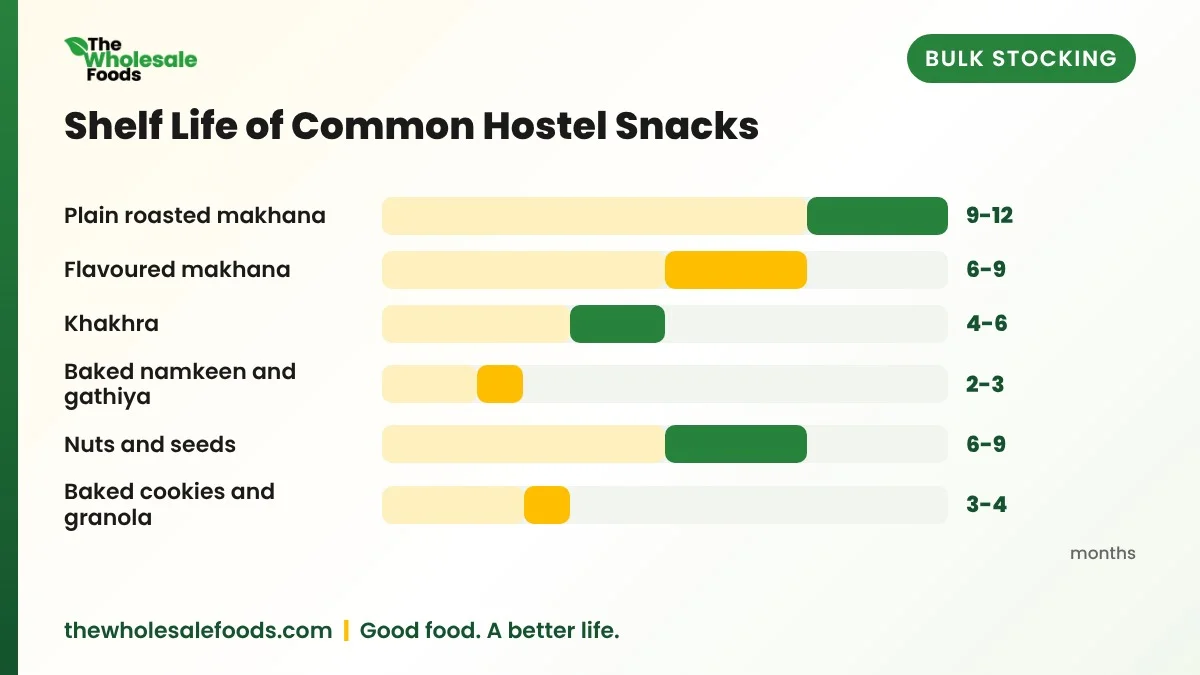
Read the pack for the best-before date and the manufacture date, and refuse anything with less than two-thirds of its shelf life left. That single rule prevents most of the wasted stock in a hostel store. For a fuller read on which snacks hold up, see Baked not fried snacks.
Storage and Freshness in the Store Room
Bulk pouches only stay good if the room they land in is set up first. Deal with the room before the delivery arrives.
- Raise everything off the floor. Keep cartons on wooden or steel racks at least 15 cm above the ground, away from the wall, so damp from the floor does not reach the packs.
- Decant opened bulk into steel bins. Transfer opened makhana, khakhra and nuts into airtight steel or glass bins with lids. A cloth bag or an open carton lets in moisture and moisture is what kills crunch.
- Label every bin. Write the item, the batch or best-before date and the date it was opened on masking tape on the bin. Servers rotate stock correctly only when the dates are visible.
- Follow first in, first out. The older bin goes to the counter first. New cartons go to the back of the rack.
- Keep the room cool and dry. A fan or a ventilator matters more than a fancy rack. In the monsoon, run the fan for an hour after the rain stops and keep the door shut during the humid hours.
- Never store snacks near the kitchen. Heat and frying oil drift into an adjoining room and settle on dry snacks within a week.
Unopened wholesale pouches keep well at room temperature. Once opened, finish a 1 kg pack of khakhra or namkeen within three to four days, and makhana within five to seven. If a batch has gone leathery, do not re-fry it. Break it into a chaat mix with nuts and raisins and run it as a special counter.
What to Check Before Buying in Bulk
This is the part most hostel orders get wrong. Ask for these before payment, not after the first delivery.
- Pack size and how it opens. 10 pouches of 100 g per carton is easier to issue than one 1 kg loose bag, because an unopened pouch is hygienic and a student can carry it to a room.
- Shelf life on the actual cartons. Ask for the batch dates for the lot being dispatched, not a general number from the catalogue.
- Full ingredient list and allergen note. Nuts, wheat, milk and coconut appear in most snack mixes. Print the ingredient list once and put it on the counter board for students with allergies.
- FSSAI licence on the label. Every pack should carry the licence number, the FSSAI mark, the net weight, the best-before date and the seller's details.
- Storage instructions. Some packs say "store in a cool dry place" and others say "refrigerate after opening". Know which is which before they reach a hostel store room.
- Samples and a small first order. Take a sample lot, put it in front of 10 to 15 students for two days, and only then commit to a full term. Ask for a split delivery so you are not holding 90 days of short-shelf-life stock.
- Issue list for resale or mess accounts. If the counter is run by a contractor, get a written item-wise issue list so stock is reconciled weekly.
One honest limit: no snack mix makes a mess nutritionally complete. Students still need hot meals, milk, fruit and water, and the snack counter supports that rather than replacing it. For students with diabetes, coeliac disease or a diagnosed nut allergy, check with the college doctor or a dietitian before adding an item to the common counter. Whole nuts and round makhana are a choking risk for children under five, which matters only if the hostel also houses young children.
Exam Season and Festival Changes
A hostel eats differently in the last three weeks of a term. Study hours shift later, so the evening slot gets heavier and the morning slot gets lighter.
- Add a second evening service from 9 to 10 pm during exams, using the pre-packed trays from the day's stock rather than opening fresh cartons.
- Shift the mix toward nuts and makhana and away from biscuits, because a dry handful at 11 pm stays crisp in a book bag.
- Cut the sweet line by a third in exam weeks. Breakfast is skipped more often than it is delayed.
- Run festival counters separately. For Diwali or a festive week, order a festive batch a month ahead and put it on its own counter for one or two days rather than mixing it into daily stock. The Diwali snacks guide covers festive items, and for gift hampers for staff or wardens there is a Corporate snack gift box checklist.
- Keep a guest-day buffer. Parents' visits and festives bring extra 20 to 30 people at short notice. Hold back 10% of the makhana and khakhra stock for exactly this.
For a counter that has to look good as well as feed people, the Wedding snack counter bulk guide has plating and presentation ideas worth borrowing.
Conclusion
Good hostel snacks for students bulk ordering comes down to three decisions made before the order: the portion in grams, the shelf life that survives your store room, and a mix built around four slots instead of a shopping list. Set 25 g at the counter, buy only packs with two-thirds of their shelf life left, and keep the flavour range narrow so nothing ages on the shelf.
Build your mix from the Makhana range, the Khakhra range and the Nuts range, or browse the full Shop. For a term order, a PG block or a canteen contract, send the details on the Quick Order page or write to sales@thewholesalefoods.com. You can also reach the team on WhatsApp at +91 63528 07509 or through the Contact page.
Disclaimer: This article is general food and nutrition information, not medical advice. People with health conditions or allergies should follow their doctor's advice.